
In doing research for the Trip Ideas page, I found a webpage from the Alberta government for ice monitoring in major rivers. I didn’t even know the government did that! It’s not like the old days, when people used the river for transportation and really needed to know when it was breaking up or how far the ice had retreated. This webpage will be great for us though, to see how open the Peace River is and when we can get out there in spring!
It doesn’t look like they monitor the freeze up, though — I only see reports for break-up. The scientist in me wants more data, but the paddler in me is satisfied with spring conditions only; the water stays open in autumn far longer than one would actually want to paddle it — November is just a bit too cold for most of us! Unless you’re training for an Arctic expedition, in which case, bring it on! 🙂
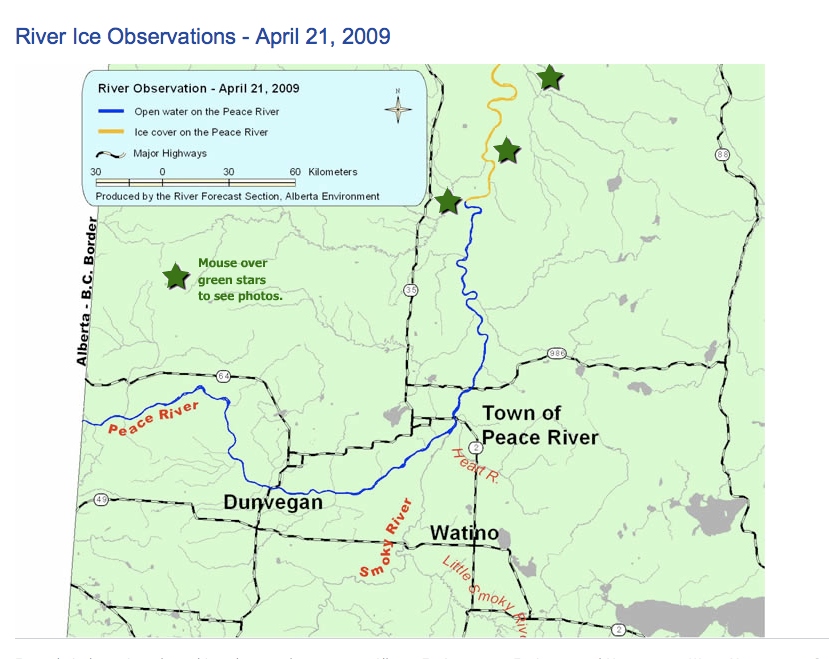
There’s an interactive ice conditions map, which shows the ice front (the image below is not interactive, though):
This is what you see when you mouseover the green star near the ice front (the most southern star):
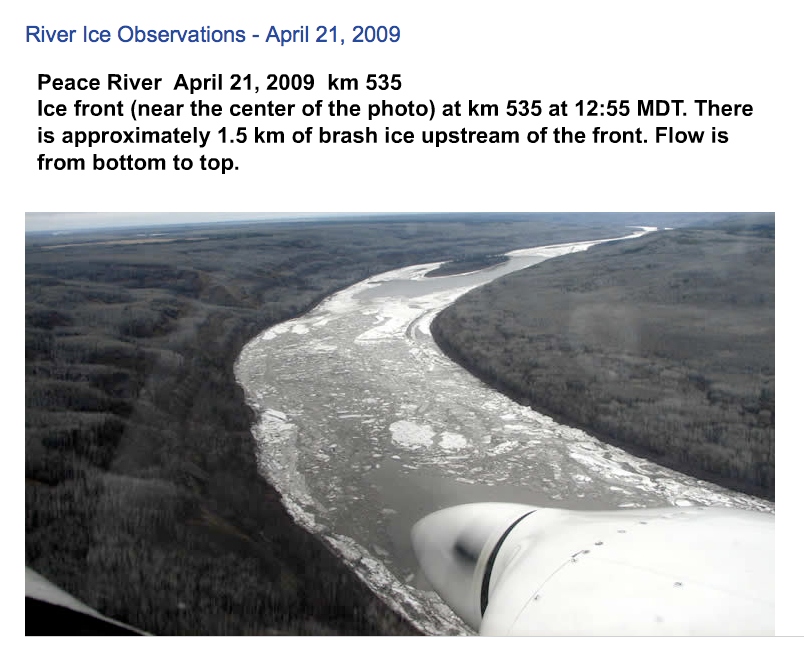
Both these were taken from screen shots from the April 21, 2009 report. Photos courtesy of Alberta Environment.
So, besides water levels, weather info, rainfall, we now have access to ice reports as well. If only there were strategic webcams… I wonder how hard that would be? If AMA can do it for road conditions, why can’t we make one for river conditions? 🙂
As usual, time is flying by and autumn’s long gone, replaced by the snow and cold of winter. All the lakes around here are covered in ice, although the rivers aren’t completely frozen over. I’m not sure if the ferry at Tompkins Landing is still operating, or if they are using the ice road yet. It’s less than a month to the shortest day of the year, winter solstice, and while it’s instinctual to hunker down and wait it out, that’s just not practical!
So what to do for the winter? While other sports or hobbies — some of them indoors — take front stage, it’s still fun planning the next trip, or a new place to explore. Cruising Google Earth* is a great way to see the world from above; some areas capture your attention and just make you want to go!
Another great thing to do over the winter is work on your health and vitality. You might think winter is the time when your health goes downhill (during the “flu season”), but it doesn’t have to be that way. Let me share 3 simple things I do to help keep myself healthy over the cold months:
1. Take Vitamin D. Vitamin D is not a vitamin at all — it’s a chemical produced in the skin naturally when you’re in the sun. But, in winter especially, there’s a very good chance you are Vitamin D deficient. Unless you live in the tropics and spend lots of time outside, you should take 1,000 to 4,000 UI of Vitamin D daily. What’s it good for? Vitamin D is important to so many body functions, it’s hard to list them all! Your immune system, heart, nerves, muscles and bones, and your mood will all benefit from more Vitamin D. For more info, check out the Vitamin D Society’s webpage or this page.
2. Limit your sugar intake. Sugar is an immune-system inhibitor, so if you suspect your immune system is weak, avoid sugary foods. Sugar replacements are not a good alternative, unfortunately, as most are treated as a toxin that your liver has to process. Stick to honey as a sweetener, or just eat fruit! Sugar competes with Vitamin C, an essential vitamin for immune system function, so if you know you have eaten a fair bit of sugar, take extra Vitamin C, or eat foods loaded with it, to counteract the sugar.

3. Stay active. If you’re like me, you’d rather be doing something fun and active outside, but when it’s -25°C, or just plain dreary, it’s tough. Why not try a nice, warm indoor alternative? You could try yoga, rebounding, swimming, t’ai chi, or even just simply stretching. I’ve got Stretching by Suzanne Martin and highly recommend it.
Whatever you do, keep a positive attitude about it! If you tell yourself that what you’re eating or doing isn’t healthy, then it won’t be.
* If you don’t have Google Earth on your computer, try Google Maps. Select “satellite” from the top right-hand corner of the image, and you will see the same imagery that’s used in Google Earth (it works best with a fast internet connection).